
Person-to-person connection is possible in online classes
NTUST created a multicultural environment
The development of the Internet and transportation brings society to the whole world. As focusing on international education, a multicultural environment plays a significant role. Having contact with plenty of different cultures helps students broaden their horizons, have global perspectives, improve communication skills, and be more confident when conversing with foreigners. In the era of COVID-19, the opportunities for students to go abroad are decreasing. They can only see the world from the news but have no experience exploring local customs and foreign cultures in person. Some remote areas in Taiwan contain worth sharing cultures but are limited to having contact with the outside world due to their location. Students in those areas lack global perspectives and the chances to have them.
NTUST has the highest number of international students, which greatly supports hosting the i-Village Digital Learning Companion Project and creating a cross-cultural environment. With the help of this Project, Taiwanese students are able to discover the world without traveling far. Every year, about 200 students from remote areas join this project. Learning partners prepare lessons about cultural exchange, which are conducted online to invite students from everywhere. While staying at home, they can still get to know the outside world. This project connects international students in Taiwan with elementary and secondary school students in remote areas. Every week, they meet online and share about their cultures. Since this project contains international students from all over the world, the topics vary in each session. They introduce the cuisines, attractions, festivals, and hobbies in their countries, meanwhile, increase the opportunities for students to practice English through interaction in class. After joining the project, students’ perceptions towards English learning started to change, as well as their opinions on non-mainstream countries. Learning partners accompany them to step out of Taiwan and open up their minds to understand different cultures. The following are the reviews from the students after having lessons with international learning partners “I get to know more about other countries.” “Now I know that some countries celebrate Chinese New Year as we do! I really learned a lot from the lessons.” “My mom is a Vietnamese, but I didn’t know there are so many attractions I can visit there.” As they stated, no matter their genders, learning stages, or learning experiences, they are not familiar with multicultural education. The project provides students a new method to learn. There is no need to overspend to travel abroad, and they can still interact with their foreign teachers.
Furthermore, international students in NTUST enjoy the project as much. “Joining the project helps me understand Taiwanese cultures.” “Taiwanese indigenous cultures are so special! I am impressed by their festivals, costumes, and food.” “I look forward to having lessons with the children every time. They are willing to share, and they also let me know the uniqueness of cultures. We are both learning from the lessons.” The project allows students not only to recognize their own cultures but feel proud to be part of it. With foreign teachers’ guidance, they broaden their horizons. Meanwhile, foreign teachers are able to experience Taiwanese cultures and appreciate different cultures.
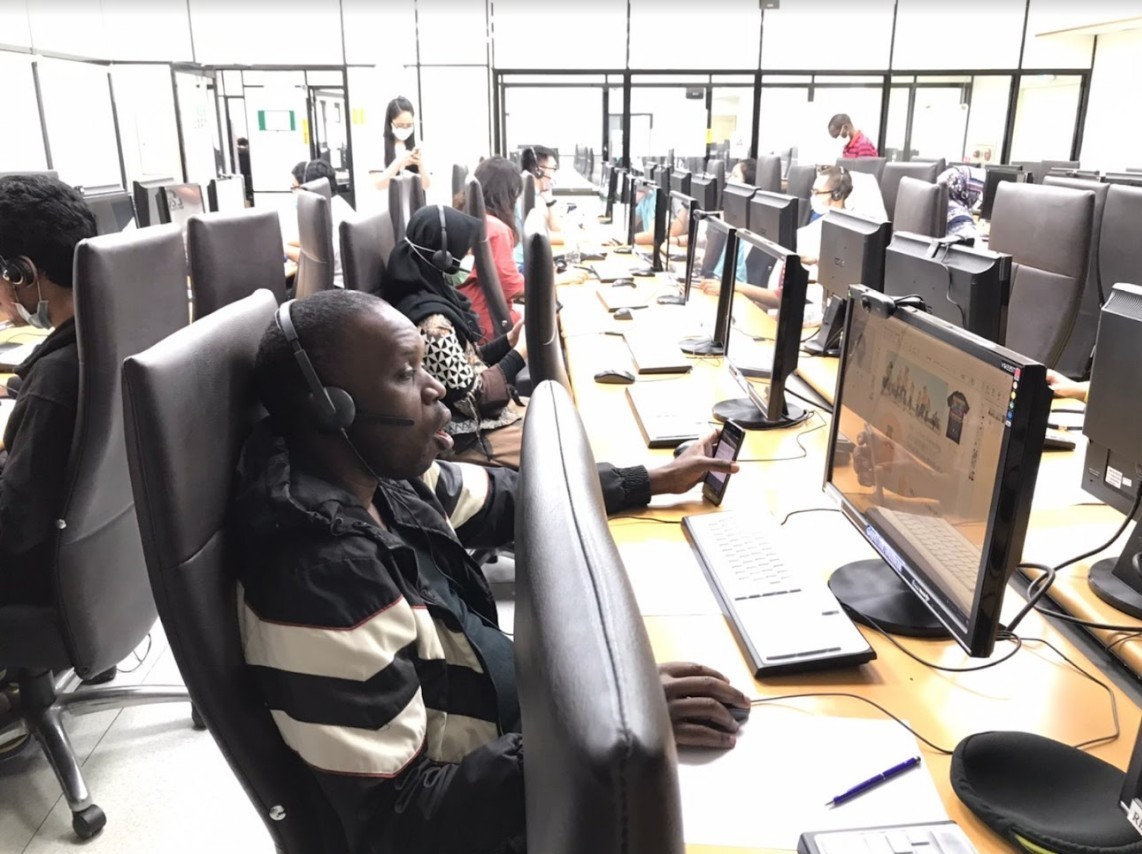 |
| Distance Digital Cultural Exchange Online Course |
Augmented reality used to recreate the historical scenes of the ancient Honpo in Daxi
Jiang Kaiqun, a Ph.D. student from Graduate Institute of Digital Learning and Education, the National Taiwan University of Science and Technology, combined augmented reality (AR) and film records to recreate the historical scene of the 100-year-old cake shop in Daxi Old Street. AR is created based on the activation of the digital content of the "Yuan Gu Benpu" formerly known as the Gu Yufa Company. When scanning the picture by using a mobile device, you can see the grocery store's lively voice, accounting, pastry molds, and other effects of historical restoration of sound and images. The video allows the public to experience the atmosphere of the old age of the "Yuan Gu Honpo", thereby becoming a platform for local creation and attracting more young people to pay attention to historical sites and culture. In addition, Jiang Kaiqun also participated in the restoration of some houses and proposed to decorate the abrupt electric boxes with beautiful bamboo art to preserve the beauty of the antique old houses.
Jiang Kaiqun said that he is a native of Daxi, Taoyuan, but he had never known that there was such an old house full of history and culture in the Old Street before. When participating in the project, he interviewed the owner of Yuangu Benpu, Ms. Gu Zhengjun, and the local elderly and had the opportunity to gain a deep insight into the history of Daxi. In order to attract more young people to pay attention to the historical sites and culture of Daxi Old Street, he used creativity to condense and restore the historical scenes as well as present interesting and vivid historical stories through using AR.
For the fifth generation of Gu Zhengjun of the ancient family, Yuangu Benpu is a "place of immortality". Despite a long history, it has a spirit of immortality. After activation, it becomes a platform for local creation and attracts many foreign experts to come and learn the historical and cultural preservation experience of the old house. Gu Zhengjun said that the cooperation with Taiwan University of Science and Technology through AR technology would reproduce the daily conversations of local businesses in Taiwanese and Japanese intercourse and restore the classic memories of the old era of Daxi. He hoped that people could visit here quietly and feel the ancient history of Daxi.
National Taiwan University of Science and Technology combines digital technology with cultural content and uses innovative methods to preserve Taiwan’s traditional culture. Through the participation of relevant courses or programs, students have the opportunity to visit historical and cultural sites, interact with the elderly and residents, and apply what they have learned to produce AR-guided tours or videos to illustrate the cultural history from a new perspective and express the concern for society.
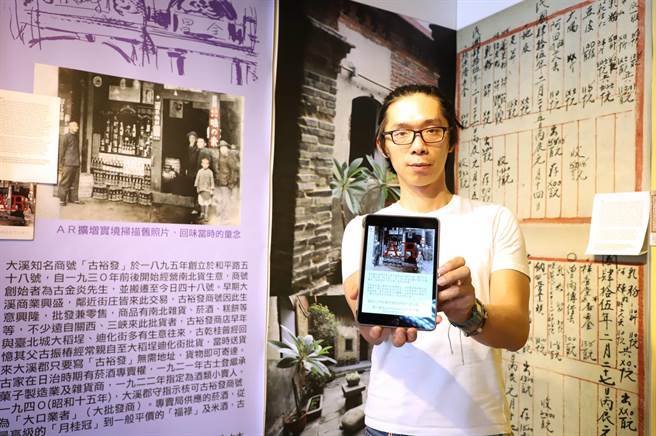 |
| Jiang Kaiqun, a Ph.D. student from Graduate Institute of Digital Learning and Education, the National Taiwan University of Science and Technology, combined augmented reality (AR) and film records to recreate the historical scene of the 100-year-old cake shop in Daxi Old Street. |
Digitized teaching material for the conservation of the building technology of traditional Taivoan bamboo house
The 2019 version of ”the Curriculum Guidelines of 12 Year Basic Education” by the Ministry of Education has brought new challenges as well as opportunities. With limited resources, it becomes a shared concern by the rural technical high schools regarding how to build the school-specific curriculum which are beneficial to both college- and job-market minded students. To address this issue, NTUST department of architecture works with the National GuanShan Vocational Senior High School(NGVSH). The focus is to create lab-oriented courses aiming to revitalize local traditions in arts and crafts. These courses offer systematic leanings in highly thought for craftsmanship with background knowledge in liberal arts.
The first project is the bamboo house of Taivoan tribe, the native people residing in GaunShan area for more than 150 years. Under the guidance of local Taivoanese Maestro Wang, students from NTUST and NGVSH reconstructed a traditional Taivoan bamboo house in NGVSH campus during the winter of 2021 with detailed documentation. A team of architectural students of NTUST use these material to develop the bamboo-house-building textbook for NGVSH. The textbook are structured with hand-on learning units in the sequences of the introduction of bamboos and vines, the tools, the building techniques and the construction processes. Each units contains notes, hand drafts, photos and demonstration video clips.
The outbreak of COVID19 pandemic in Taiwan in May forces the teamwork to move online. Using computer screen as the platform of communications, it helps the student team to edit the digital book with wide screen format. All the demonstration video clips are marked with QR codes in the digital textbook and uploaded to YouTube. The digital learning curriculum has been handed over to NGVSH over the summer. In the fall semester, the textbook will go through the pilot test. The volunteered students in NGVSH will build a small bamboo house under the guidance of the digital learning material with the assistance of online discussion with the partners in NTUST.
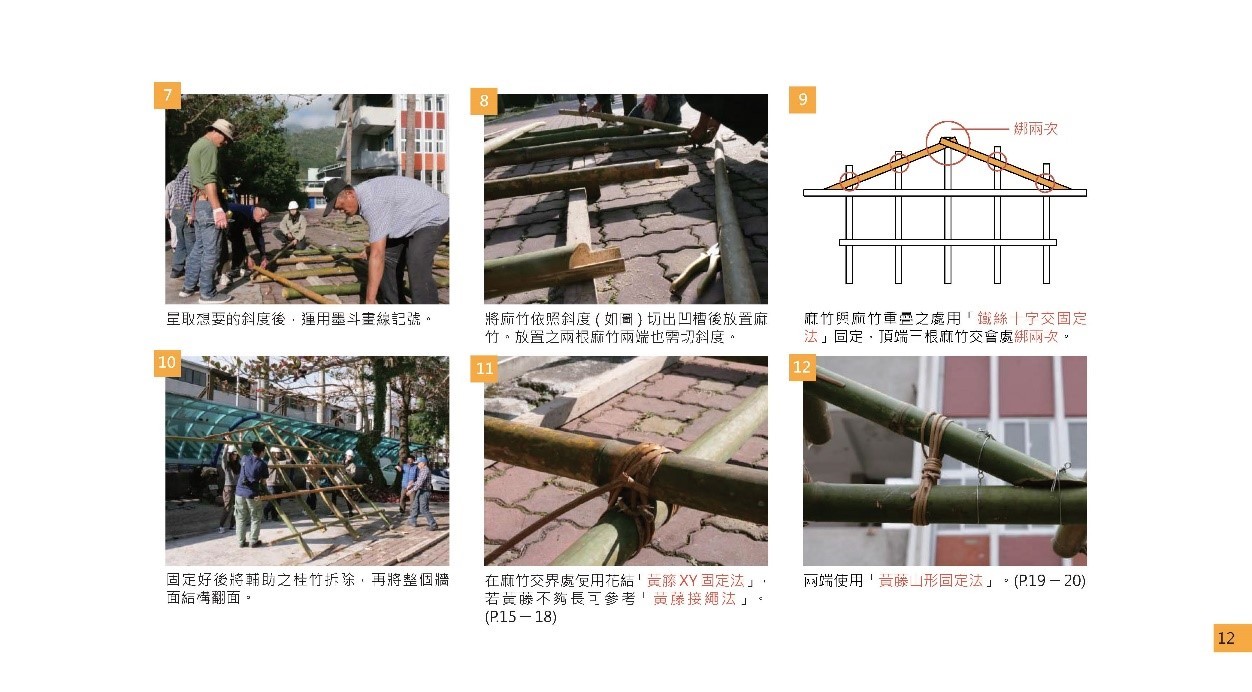 |
| A sample page of the digital textbook for the construction of Taivoan bamboo house |