
Younger and older generations engage hand-in-hand in mutual learning and create unique community courses
The university connects local communities and promotes intergenerational mutual learning
The National Taiwan University of Science and Technology (NTUST) launched the “I Design I learn —Creating an Interactive and Smart Living Environments for Intergenerational Learning” project in 2020. Targeting issues related to promoting the health of senior citizens, the cross-disciplinary team formed by members of the Department of Design, Graduate Institute of Digital Learning and Education, Graduate Institute of Biomedical Engineering has connected community hospitals and educational institutions and organized for students to go into the community to determine its situation and the actual needs of older residents. Training courses have also been organized to give the students an understanding of the importance of issues such as caring for older adults and intergenerational interaction. The team has also worked with community agencies to introduce diverse and unique courses to the communities. These courses have encouraged senior citizens to paint a new world for themselves by using music and color to tell their life stories through multimedia animations; these activities have helped the senior participants rediscover their values and confidence and have slowed their aging process.
In this project, the NTUST has acted as a hub connecting local communities and providing these communities with diverse creativity-based activities. Apart from taking care of older adults in the community and reviving a sense of community among residents, the NTUST has met its social responsibility through this project. The practical sessions have enabled students to understand how their self-designed devices and assistive tools can be practicably applied with older adults; this has, in turn, enhanced their sense of social responsibility and rendered the university a great partner in cultivating local forces for local communities. This project serves as an excellent example of intergenerational mutual learning and implementation of community-based creative aging measures.
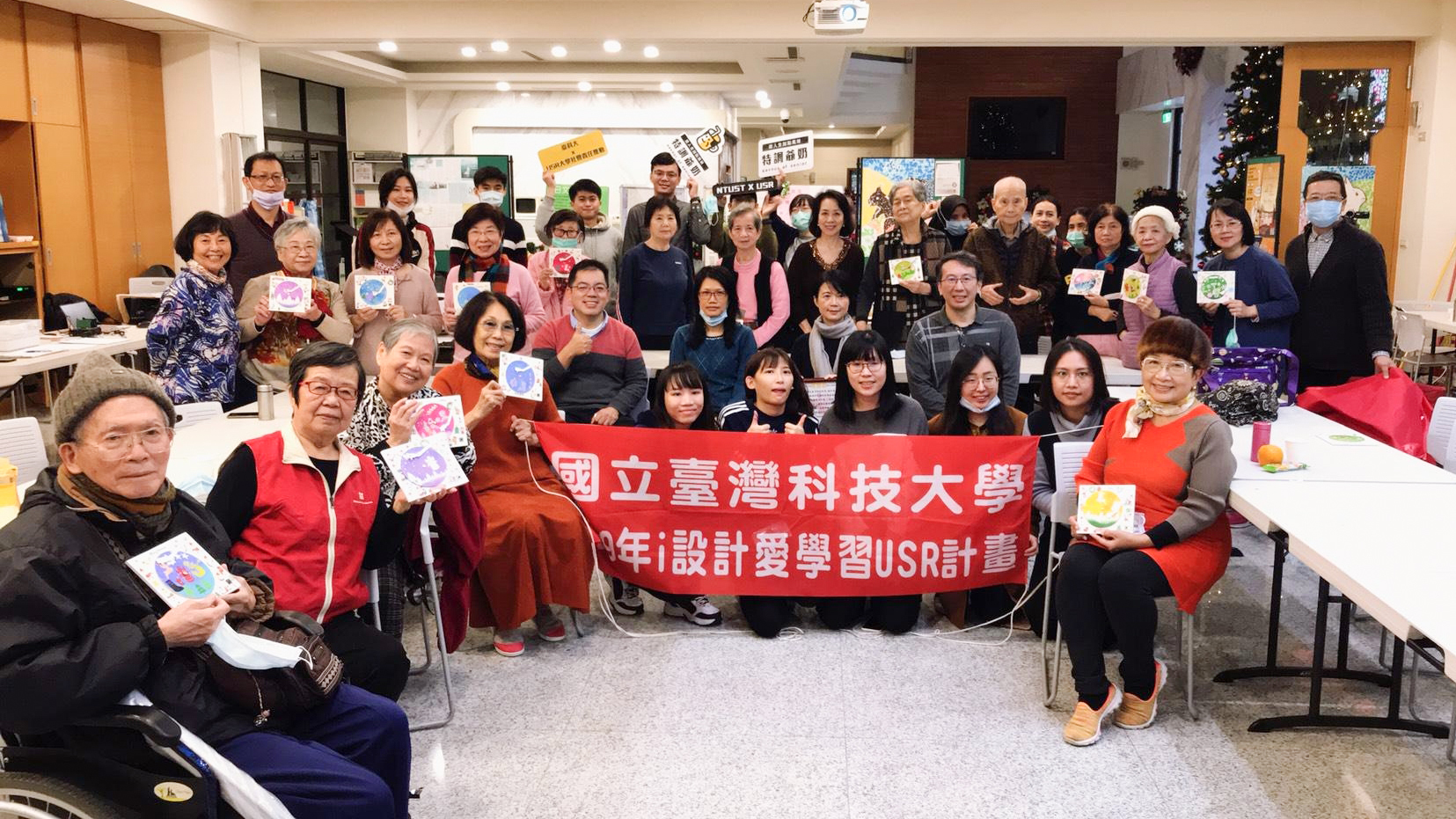 |
| Group photo of the “I Design I learn” project team, taken during the outcome presentation session held at the 183 He-Ping Senior Caring Center. |
Parallel execution of medical and humanistic care with the hope of slowing the aging
Regarding issues related to the senior population, the project involves strengthening the “Primary Prevention” caring mode. Hsin Hsiu, a professor from the Graduate Institute of Biomedical Engineering, has led the students in providing health suggestions related to blood vessel condition and chronic diseases to older adults in the community; this has been achieved by measuring blood supply signals and analyzing physical parameter data collected using the self-developed smart wearable band and ring devices. Older adults with high risk have been advised to receive treatment at the hospital, whereas those with low risk have been arranged to participate in related activities planned for the community in the project such that their risk of Alzheimer disease could be reduced.
Older adults generally regard the creation of art an inaccessible activity. Associate Professor Fang-Wu Tung from the Department of Design has led students in forming a “savour of senior” team, which has explored older adults’ needs when engaging in creative learning in senior community centers. The team has developed a creative aging course, gamified teaching aids, and devices that help older adults create art. In the creative aging course, senior participants have experienced free production of creative work based on their own experience and have used multimedia materials such as colors, music, clay, and Chinese ink wash painting tools; this has enabled them to express themselves and resulted in an overturn of the impressions that they had regarding art creation.
Associate Professor Yi-Ming Kao from the Graduate Institute of Digital Learning and Education has connected with junior high school students to organize intergenerational mutual-learning multimedia workshops in the community; in these workshops, participants have created 11 animations enriched with humanistic emotions through the integration of digital technology and local sentiment. In the co-learning course, the students gain the perspective of life wisdom through the personal stories of the senior participants, whereas the senior participants experience being listened and paid attention to. Apart from closing the gap between the younger and older generations, the co-learning course helps pass on local values and life wisdom.
 |
| University students leading junior high students in interviewing seniors in the community about their life. |
Cross-era integration that closes intergenerational gaps
The creative aging course not only enhances seniors’ receptivity toward art courses in the community but also provides the seniors agency by providing diverse creativity-based activities. After completing activities in the creative aging course at the senior center, the participating students can witness the astonishing creativity and learn the rich life experience of the senior participants; the students believe that a co-learning relationship exists between them and the senior participants. A student who participated in the activity stated, “By actually going into the community, we as well as the senior adults benefit from the course because we learn from each other and exchange information. Rather than saying that we are teaching them, I think we are participating in their life, and they learn about the innovative thinking of the younger generation from us.”
Junior high students and community seniors participate in the multimedia workshop, but university students are also involved in the preparation, design, and execution of the workshop; a student who participated in the activity after multiple project conceptualization and modification sessions shared, “The suggestion that this activity made to me is that we would face many unexpected situations at the education site. In the intergenerational course, we were unable to take all junior and senior learners into consideration. Therefore, we needed to add an attention-shifting component to the course to attract the learners’ attention; this is a future area of improvement for me both in terms of camp organization and education skills.” A student who participated in the blood health testing activity for older adults shared, “Feedback from the older adults in the community is the main factor affecting my motivation to recruit participants. Their reaction when receiving the feedback card, be it a simple thanks or a smile, makes me feel that the hustle and bustle is worth it.”
Through interactions such as arranging lectures in the communities, organizing intergenerational workshops, and providing a blood health measurement service, the younger generation can learn to see the senior population from empathy; this minimizes the gap between the different generations. Furthermore, individuals from both generations can learn from each other and co-create value through these activities.
 |
| The participating students providing blood vessel health testing at the community agency. |